
Water trading ranks among the most effective ways to earn credits in Probably Stolen. Players kick off with basic filtration equipment and can boost water quality through purification tablets and advanced machines, attracting buyers willing to pay top prices. This guide will help you turn water into a thriving business, covering everything from your initial stock to sophisticated Rustwater filtration techniques.
How to Sell Water
It’s critical to hang onto your starting 6L jug. You’ll find it invaluable for processing larger water quantities, and replacing it early in the game can be quite a challenge.
Don’t forget to hang onto your initial 6L jug, as it’s going to be crucial for when you start processing larger quantities of water. Trust me, finding a replacement for it early in the game can be quite a challenge, so make sure you keep it close!
How to Test Water Purity
As a Water Trader, you kick things off with some testing strips in your gear. To get started, pop open the container that holds these strips and grab one. Simply drag a strip into any body of water, and you’ll see a reading of its purity percentage. This little number is super important since it directly impacts the quality of the water and how much you can sell it for later on.
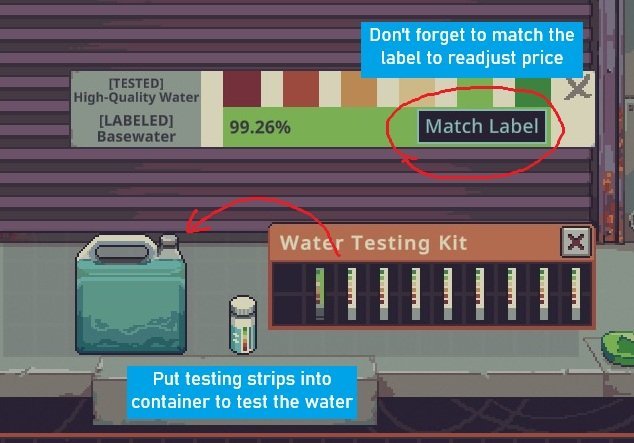
Instead of testing every small bottle individually—what a waste of strips—you should mix the water in your larger 6L jug and carry out a single test on that combined batch. It’s much more efficient.
Always test water from merchants. Sometimes sellers don’t label their water correctly, and appearances can be deceiving, so don’t spend your credits without confirming purity first.
Here’s a quick rundown for testing before you buy:
- Basewater: Always check labels and test for purity before purchase.
- Ghostwater: Darker hues can mean lower quality, so confirm it’s legitimately Basewater before buying.
- Rustwater and Gutterflow: They demand more effort than typical water and aren’t ideal for beginners.
Don’t hesitate to confront sellers if you suspect they’re mislabeling their water. Calling them out can sometimes mean getting a price drop for you.
How to Buy Water Without Getting Scammed
Purchasing water is a smart way to help establish your trading business before you’ve got a reliable supply of your own. But a word of caution: resist the urge to blow your early funds on big batches of water that haven’t been tested yet. It’s better to be cautious and ensure you’re investing wisely!
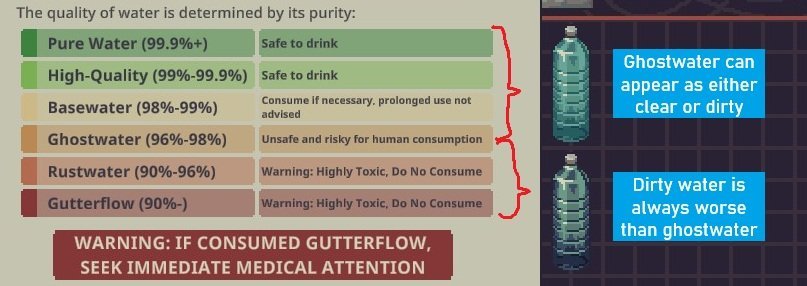
Use these guidelines when making purchases:
- Always test bottles with your testing strips when feasible.
- Be wary of any unusually dark water and verify quality before paying up.
- Avoid acquiring large 2L bottles without confirming their purity first.
- Save up for better equipment rather than emptying your wallet on questionable stock.
- Whenever you can, make sure to test bottles with those handy testing strips.
- If you come across water that looks suspiciously dark, be sure to check its purity before agreeing to the listed price.
- Steer clear of purchasing large quantities of 2L bottles without verifying their purity first.
- It’s wise to save your coins for upgrades or gear that can boost your water supply and speed up your processing!
Remember, a cheap bottle of water is not a deal if it’s heavily contaminated; that could seriously hinder your ability to process it into high-quality water.
Basic Water Trading: Filtration
A crucial change is that filters no longer eliminate microbial contamination. Before filtration, you must treat for contaminants with either purification tablets or a UV lamp.
Here’s how to correctly filter your water:
- Start by placing the contaminated water into a suitable container.
- Treat the microbial contamination using either a Water Purification Tablet or UV Lamp.
- Attach a Water Filter to your pitcher.
- Transfer the treated water into the pitcher.
- Finally, collect the filtered water into a new container.
- Always test the final product before you decide to label it as high-quality for sale.
Basic filtration steps
- Begin by placing the water you wish to process into an appropriate container.
- If there’s any microbial contamination, treat it using a Water Purification Tablet or a UV Lamp.
- Next up, attach a Water Filter onto your water pitcher.
- Carefully pour the treated water into your pitcher.
- Make sure to collect the filtered water in a different container.
- Finally, give it a test before you market it as high-quality water!
If you notice the results aren’t quite what you expected, it’s a good idea to check the durability of your filter. A filter showing 0/400 durability definitely needs replacing before you attempt to process water again, so keep an eye on that!
If the output is lower in quality than expected, double-check the durability of your filter; a filter at 0/400 durability should be replaced before it can process more water.
Why filtration sometimes fails
A functional filter doesn’t guarantee high-quality results. Here are two frequent issues that cause lackluster purification:
- Remaining microbial contamination: Always use a Water Purification Tablet or UV Lamp before filtering.
- Excessive chemical or heavy metal contamination: Standard filters can’t effectively remove these materials to meet the high-quality standards.
- Microbial contamination is a concern: To ensure your water is safe, it’s a good idea to start with either a Water Purification Tablet or a UV Lamp before you go ahead with filtration.
- When chemical or heavy metal levels are too high: Standard filters just won’t cut it, as they can’t effectively remove enough of these contaminants to meet the high-quality standards we aim for.
To achieve high-quality water, it needs to have at least a 99% purity rating. Any water testing at 98–99% purity may still require further treatment or should be diluted with water that has a higher purity level.
Intermediate Water Trading: Tablets and Purifiers
Here’s a brief overview of how each piece of purification equipment works:
| Equipment | Main Use |
|---|---|
| Water Purification Tablet | Eliminates microbial contamination and lowers chemical contamination to around 0.71%. |
| UV Lamp | This removes microbial contamination and fits easily inside a water pitcher. |
| HydraTech Water Purifier | Handles contaminants effectively up to the base water quality and assists with difficult water filtration. |
| Water Purifier Machine | Takes time to treat water, gradually diminishing contamination levels. |
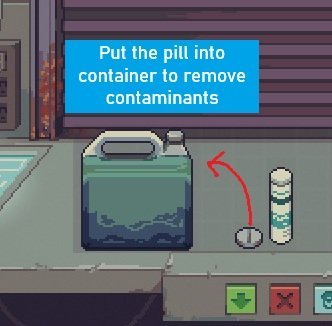
Let’s break down the role of each piece of equipment you’re going to use:
| Equipment | Main use |
|---|---|
| Water Purification Tablet | This handy tablet tackles microbial contamination and lowers chemical contamination to about 0.71% for cleaner water. |
| UV Lamp | Great for zapping microbial contamination, and the design allows it to easily fit into a water pitcher if needed. |
| HydraTech Water Purifier | This machine is your go-to for removing contaminants, especially when regular filters struggle with certain types of water. |
| Water Purifier machine | It takes its time to treat water but does a solid job of gradually cutting down on contaminants. |
The basic Water Purifier machine is extremely handy when you want to process water overnight, letting you take a break from more manual pitcher work.
How to use the Water Purifier machine
You’re going to need the following items to get started:
- A Water Purifier machine to handle the heavy lifting.
- Batteries for powering up your machine.
- Water Purification Tablets to cleanse the water.
- A 2L bottle or the robust 6L jug you’re starting with.
- Some water that needs processing.
You can purchase the purification machine from the retired merchant for 345 Credits or from Doc Jackson for 375 Credits. If you’re in need of a battery, you can also use one from your bottle printer to kickstart your setup.
Here’s how to operate it:
- Put a Water Purification Tablet into the water. One tablet typically works for a 2L bottle, while two are best for a 6L jug.
- If you have a UV Lamp, employ it first to handle microbial contamination before the machine treatment.
- Insert the water container into the powered Water Purifier.
- Leave a 2L bottle in the machine overnight; a 6L jug may need about three nights.
- Take out the water afterward and filter it through your pitcher.
- Always test it before selling as high-quality water.
- Begin by dropping a Water Purification Tablet into the water. For a 2L bottle, one tablet should do the trick, while for the 6L jug, I’d recommend using two.
- If you’ve got a UV Lamp, make sure to use it to clear out any microbial contamination before the water hits the machine.
- Next, place the water container securely inside your powered Water Purifier.
- Give your 2L bottle a good 1 or 2 nights in the machine, and for that hefty 6L jug, you might want to let it sit for about three nights.
- Once that’s done, retrieve the water and run it through a pitcher equipped with a Water Filter.
- Lastly, don’t forget to test the finished product before you think about putting it up for sale!
If the result still shows Basewater, either use another tablet, UV treatment, or let it stay in the purifier for an additional night. Testing again is key.
Advanced Water Trading: Dilution
For instance, blending equal amounts from a 99.5% purity batch with a 98.5% batch yields about 2L at an estimated 99% purity.
This method applies across various volumes; just keep in mind that the final percentage will depend on both the purity and volume of each water batch.
The concept remains consistent, even if you’re dealing with various volumes. Just keep in mind that the final percentage you come up with is influenced by both the purity and the quantity of each batch you’re mixing.
How to dilute water correctly
- First, grab a sample of your high-quality water and test it to see how pure it really is.
- Next up, test the lower-quality water that you’re thinking of blending in.
- Mix the two different amounts together in a container that’s suitable for the task.
- Finally, give the mixture another test to make sure it still hits that high-quality mark you’re aiming for.
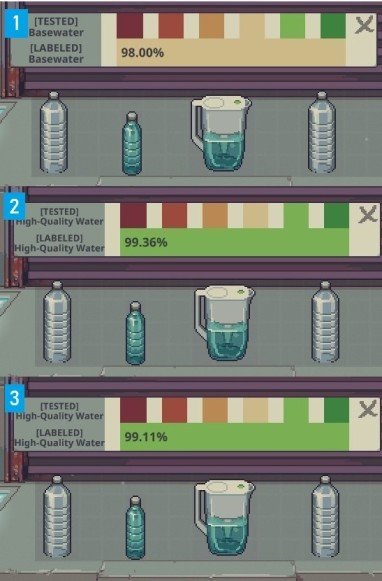
It’s important to remember that just tossing in a bit of high-quality water isn’t a guaranteed solution for a contaminated batch. If that lower-quality water has a lot of chemicals or heavy metals in it, you might have to process it a bit more before you can mix it in safely.
Having pure water on hand for dilution can also be advantageous as it helps increase the volume without sacrificing overall purity.
Attracting Upper-Level Water Buyers
When it comes to buyers at the upper levels, they tend to spend more cash compared to the average customer, making them a valuable resource once you’ve built up enough stock to display.
A full 6L jug of high-quality water is a sure way to bolster your display. It’s a good idea to hold onto Springwater rather than selling it immediately, as it might entice higher-level buyers.
One effective strategy is to have a complete 6L jug of high-quality water, which can really boost your display value. Plus, it’s a smart move to hold onto Springwater instead of selling it right away since it could draw in those higher-tier water merchants.
Don’t forget about these additional insights:
- Keep in mind, during the initial couple of weeks, you won’t see those high-end buyers popping up. It’s just part of the game’s rhythm.
- If you want to make your store more appealing, try out some appearance perks! They can really boost how much upper-level buyers are willing to spend.
- Don’t overlook discounts; they can provide a little extra wiggle room in those buyers’ budgets.
- Once you hit an impressive 20 Upper Level Reputation, you’ll start seeing those water hoarders tipping you a nice 15%!
Upper-level buyers will start visiting your establishment when you either display at least 350 Credits worth of water or label most of it as Pure Water.
Expert Water Trading: Chemical and Heavy Metal Contamination
Some types of water can still register as Basewater quality, despite your best filtration efforts. This frequently stems from chemical or heavy metal contamination, which standard filters often fail to remove efficiently.
With an Aquascan device in your hands, you’ll be ready to dig into the details of your water quality. You can snag one over at Doc Jackson’s shop—just wait for a household goods surplus to lower the price, and you’ll be all set to inspect the contams in your precious water supply.
An Aquascan device is essential for identifying contamination types within your water. You can snag one from Doc Jackson’s shop, often at a discount during household goods surplus sales.
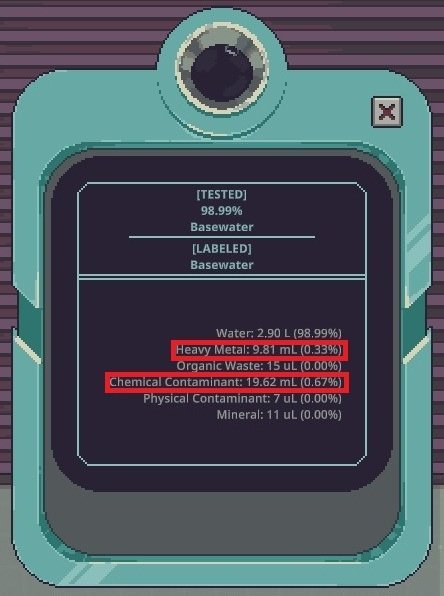
If contamination levels are low enough, dilution can solve issues, but significant contamination requires a more thorough approach.
How to Process Rustwater into High-Quality Water
Rustwater is quite a pesky opponent compared to regular water. To make the most out of your Water Filter, you’ll first need to tackle that contamination issue head-on. It’s all about cleaning it up before relying on your equipment!
Step 1: Treat the water
Your first step should be to grab a Water Purification Tablet. This handy little item will help you zap away microbial contamination and chip away at the chemical stuff, too. Just keep in mind, you’ll need to use one tablet for each full jug to get the best results.
Step 2: Reduce microbial contamination
If you didn’t use the tablet beforehand, employ a UV Lamp to remove microbial contamination prior to proceeding.
Alternatively, the HydraTech Water Purifier is a great option. It can improve some tough-to-process water into a higher-quality state.
Step 3: Reduce chemical and heavy metal contamination
If you’re looking for another way to tackle chemical and heavy metal contamination, the Sewer Tilapia is a great option! Using more of these fish can speed up the cleaning process, plus they have the fantastic ability to thrive without a filter in their tank. Talk about low maintenance!
However, don’t overlook that Sewer Tilapia create organic waste, potentially adding contamination back into the water, which your filter will then need to deal with. Always check the water after treatment, instead of assuming the fish have made it ready for sale.
Step 4: Filter the water
Once you see that chemical and heavy metal contamination levels fall to a safe point, it’s time to move that water into your pitcher and let it flow through your Water Filter. You’re on the right path to providing clean, fresh water!
Do the final tests on the processed water. If it still does not meet high-quality standards, continue treatment or think about mixing it with higher-quality water as a last resort.
Step 5: Use dilution to save time
If you’ve got some top-notch water on hand, mixing it can really cut down on the extra treatment your Rustwater needs. Just make sure to measure your mixture with care and give it a little test run before putting it up for sale.
This trick comes in handy when the leftover contamination is minimal, but don’t forget that it doesn’t substitute for good treatment when you’re dealing with water that’s heavily contaminated.
Optional: How to Scam People
Although Probably Stolen lets you mislabel water as high-quality, be warned that this poses a significant risk since buyers can still test your stock.
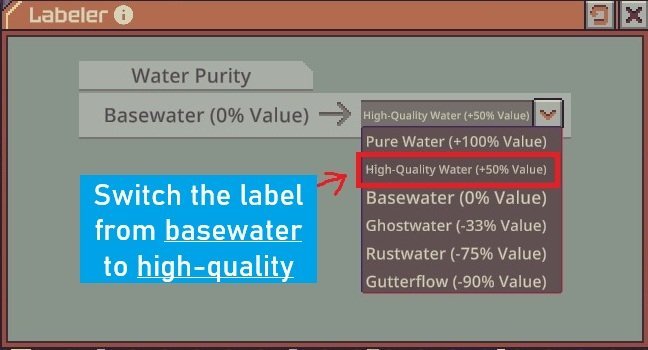
I’ve personally encountered consequences after offloading around 100L of mislabeled water.
If you choose to play around with this mechanic, keep in mind that simply changing the label won’t impact the actual purity of the water—just its appearance to customers.
If you’re feeling adventurous and decide to tinker with this mechanic, keep in mind that the label you put on it won’t actually boost the water’s purity. It just alters what your customers think they’re getting.